How many bananas is an X-ray?
And is it safe to travel by plane?
Have you ever done an X-ray? The doctor or dentist drapes a lead apron over you, leaves the room or hides behind a wall, and fires. Our brain sounds the alarm radiation, cancer, danger. How dangerous is this?
Meanwhile, you ate a banana for breakfast without a second thought - even though bananas are genuinely and measurably radioactive.
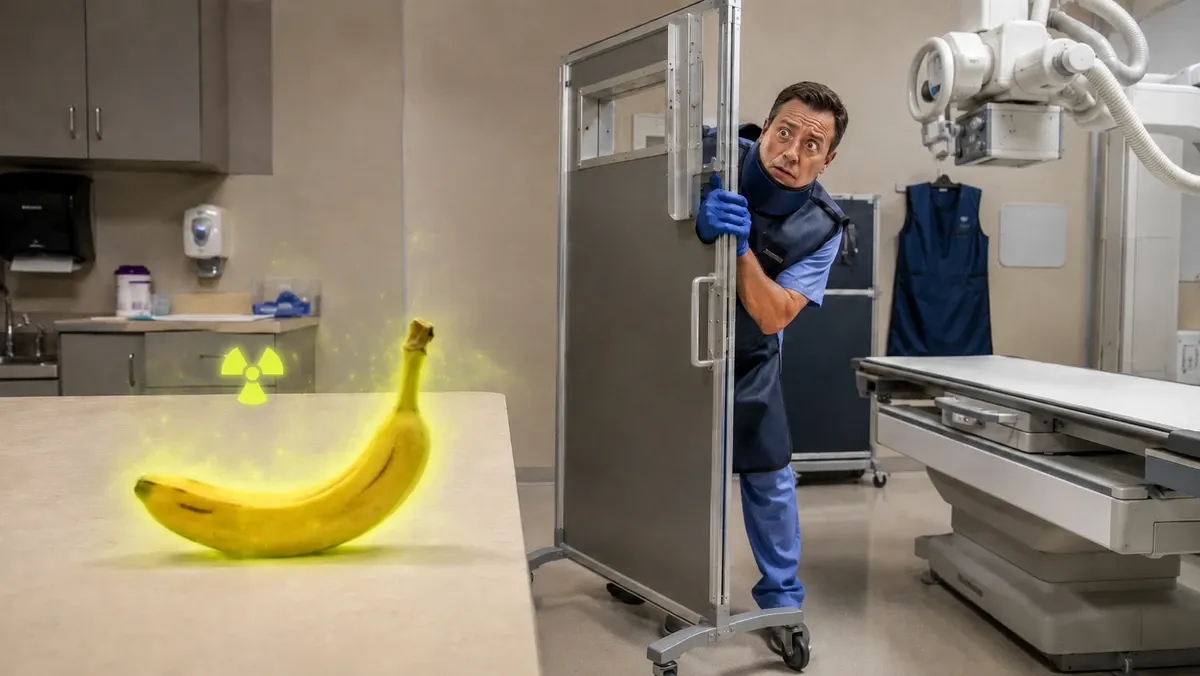
What should you worry about? Let’s break it down. Our goal will first to get a taste for intuitive units to measure radiation, and then compare them to potential life threats.
First, what are we even measuring?
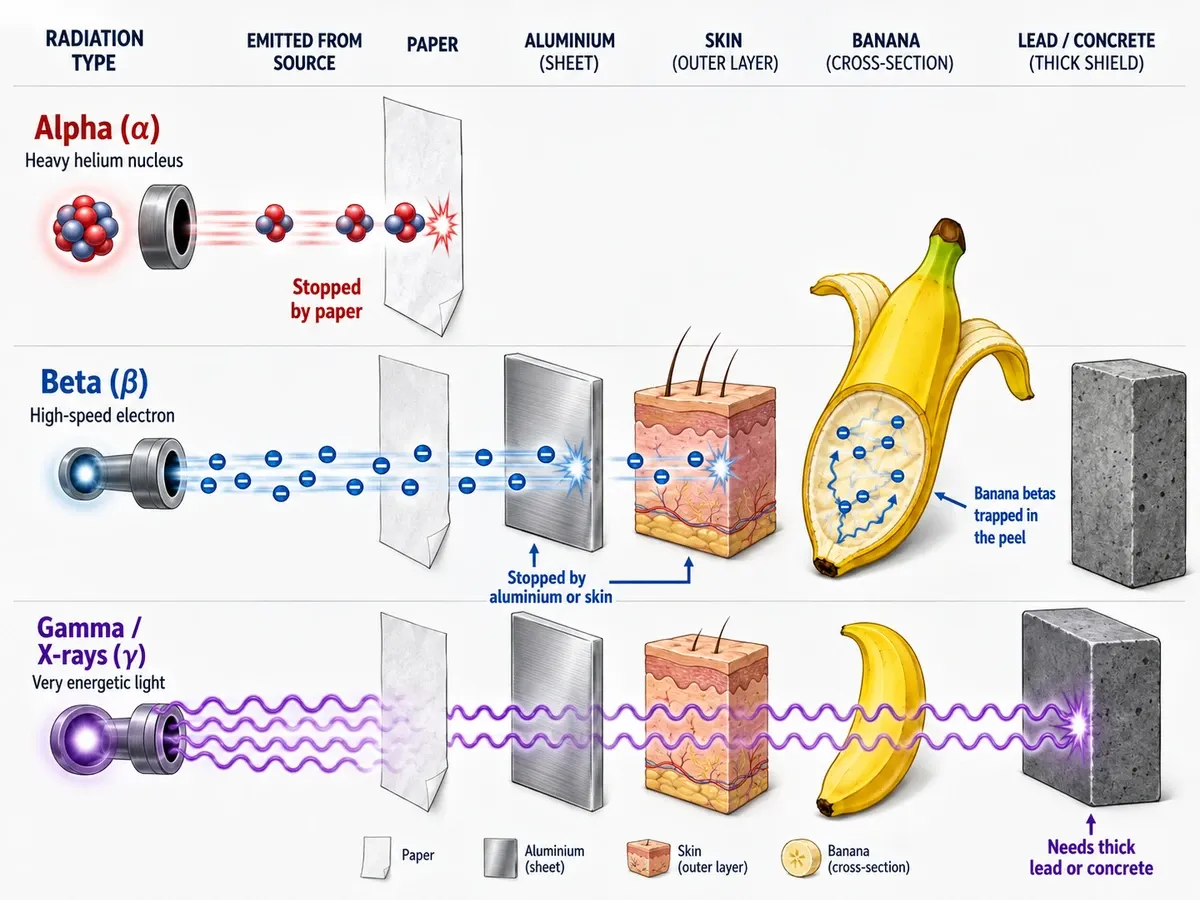
Ionising radiation means energetic particles that can knock electrons out of atoms, and hence, damage your DNA and cause all sorts of cellular problems. There are 3 meaningful categories of such particles and mixing them up is where most confusion (and fear) comes from.
The three main types:
- Gamma (γ), X-rays - pure light, just very energetic. Needs lead or concrete to stop. UV radiation is also light and can damage you, but it does not fall into the ionising category up to the strongest UV-C rays.1 This type of radiation is what medical scanners use.
- Beta (β) - a high-speed electron. It can be stopped by a few millimeters of aluminium, or a few millimeters of skin. This is mostly what bananas emit2 - and the reason standing near bananas does nothing: the betas never reach you (though they can hurt you once inside you, as we will see).
- Alpha (α) - a helium nucleus, heavy and “slow”. It can be stopped by a sheet of paper or the outer layer of skin. Harmless outside you, genuinely dangerous inside.
There are other rarer types, like proton radiation or neutron radiation.
We measure these in three units:
-
Energy - Gray (Gy). Pure physics: 1 Gy = 1 joule of radiation energy per kilogram of tissue. It doesn’t care what kind of radiation hit you. Radiation damage is not heat: a dose that kills half of those exposed, ~5 Gy, is just 5 J/kg - which would warm you by about 0.001 °C.a3 Radiation damage is molecular damage.
-
Biological harm - Sievert (Sv). The same joule does different damage depending on the radiation type, so we multiply Gy by a quality factor :
For X-rays, gammas and betas . This means that for everything in this post, grays and sieverts are the same number. For alpha particles : they’re the heavy hitters.4
-
Radioactivity - Becquerel (Bq). It describes how active the material source is: 1 Bq = 1 atomic decay per second.
The fun unit: bananas 🍌
The Banana Equivalent Dose (BED) is an informal unit invented for exactly the problem we just described: sieverts mean nothing to anyone. Plus sometimes you see Sv, or mSv or µSv, so it’s just really confusing. Rather than quote a dose, you quote how many bananas you would have to eat to match it. Why? Because bananas are rich in potassium,5 and a small share of all natural potassium is potassium-40 - a radioactive isotope that has been decaying slowly since the Earth formed. The unit typically quoted is that 1 banana = 1 BED .
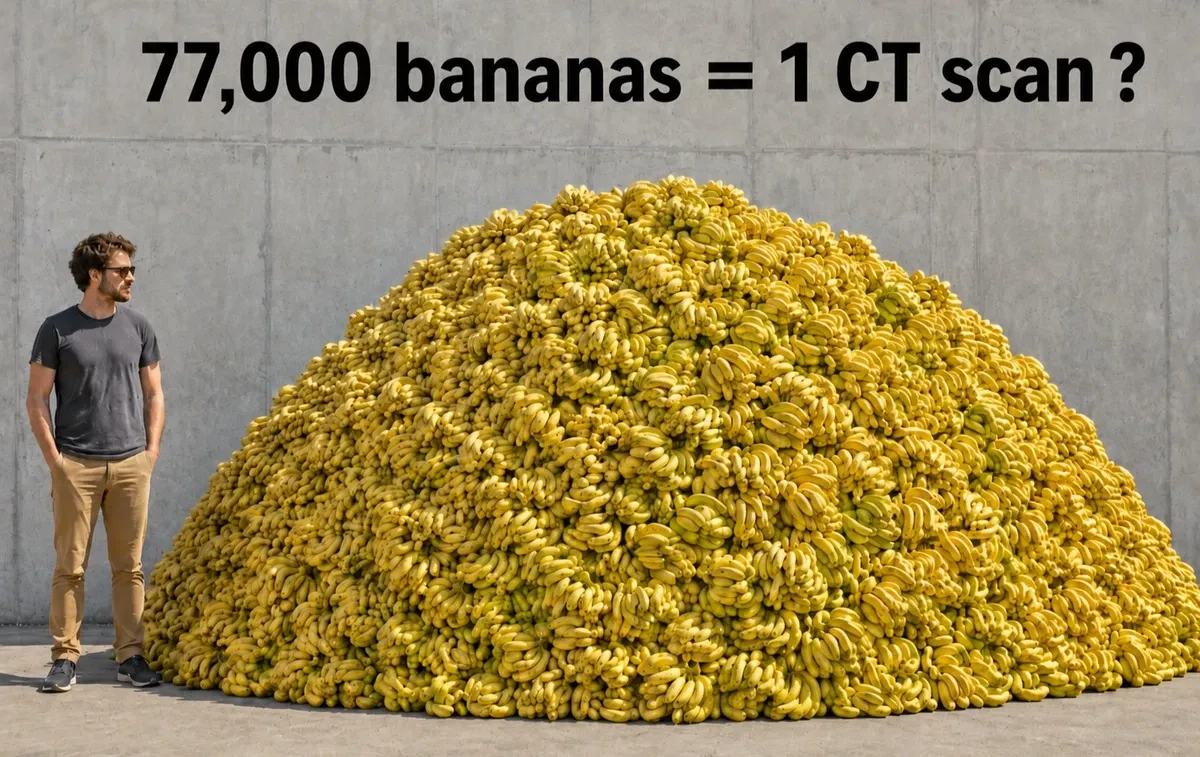
For instance, let’s look at medical exams. A CT scan that has about 7.7 mSv of radiation harm, which means it corresponds to eating 77,000 bananas. That’s a lot! Comparing scary radiations to bananas, which everyone knows are harmless, is a good trick to put things in perspective.
To start, I’d like to not take the banana dose on faith - let’s build it from scratch.
-
How much radioactive potassium per banana? A banana carries about 0.5 g of potassium,5 of which is the radioactive isotope K-40:6
-
How many atoms is that? Divide by the molar mass and multiply by Avogadro’s number:
-
How fast do they decay? The activity is , where the decay constant comes from the half-life of K-40, yr s:6
So ~16 atoms decay every second inside each banana, releasing beta radiation.
-
From decays to dose. the EPA’s (US Environmental Protection Agency) dose coefficient for swallowed K-40 is Sv/Bq.7 This bundles in the messy biology - what fraction of each decay’s energy your tissues absorb - and integrates it over 50 years. The total is:
Rounded to a clean figure, that’s the BED - Banana Equivalent Dose:
Beautiful. You may have noticed it has one clear flaw…
The problem with bananas
The issue is that the BED unit is “integrated over 50 years”, which quietly assumes something false: that the potassium stays. It doesn’t. If you were even able to eat 100 bananas, you wouldn’t get that potassium-40 accumulated in your body as heavy metals do. Your body holds potassium at a fixed level - about 140 grams, no matter what (by the same logic as above, this is 4400 Bq from your body to itself).8 Eat an extra banana and your kidneys quietly excrete an equal amount to keep the balance. The K-40 never accumulates and eating an extra banana doesn’t increase the radiation you are exposed to. Even the EPA’s own guidance warns that this coefficient isn’t appropriate where potassium intake is elevated.7
So a CT scan is “77,000 bananas” on paper, but you could eat 77,000 bananas during the rest of your life and never receive that dose for real. Even ten bananas don’t dose you ten times more than one. The BED is a unit that doesn’t add up.
When bananas do matter
Bananas in bulk are radioactive enough to matter: a truckload of bananas can trip the radiation portal monitors at US ports that are built to catch smuggled nuclear material.9
Just for fun, to actually die from bananas, you would need to eat around 100 million bananas in a year.10 Except, as we’ve established, you’d excrete the potassium as fast as you swallowed it. In fact, if you didn’t, the potassium would stop your heart long before the radiation mattered.
A better unit: one day of being alive
Every day we are exposed naturally to all sorts of radiation. It never stops, we never excrete it, and everyone is getting it. The UN’s radiation committee published a fresh assessment in 2026. The worldwide average from natural sources is 3.0 mSv per year, or 8.2 µSv per day, which breaks down as:11
- Radon and thoron, naturally present in the air breathed - 4.9 µSv/day
- Ingestion of natural radionuclides (your own internal K-40 - radioactive potassium - among them) - 1.4 µSv/day
- Cosmic rays from space - 0.8 µSv/day
- Terrestrial gamma from the ground - 0.8 µSv/day b
- Terrestrial gamma from the building around you - 0.3 µSv/day b
That last line is the surprising one: indoors you are surrounded by quarried rock rather than merely standing on top of it, so the indoor gamma rate runs about 1.4x the outdoor one.12
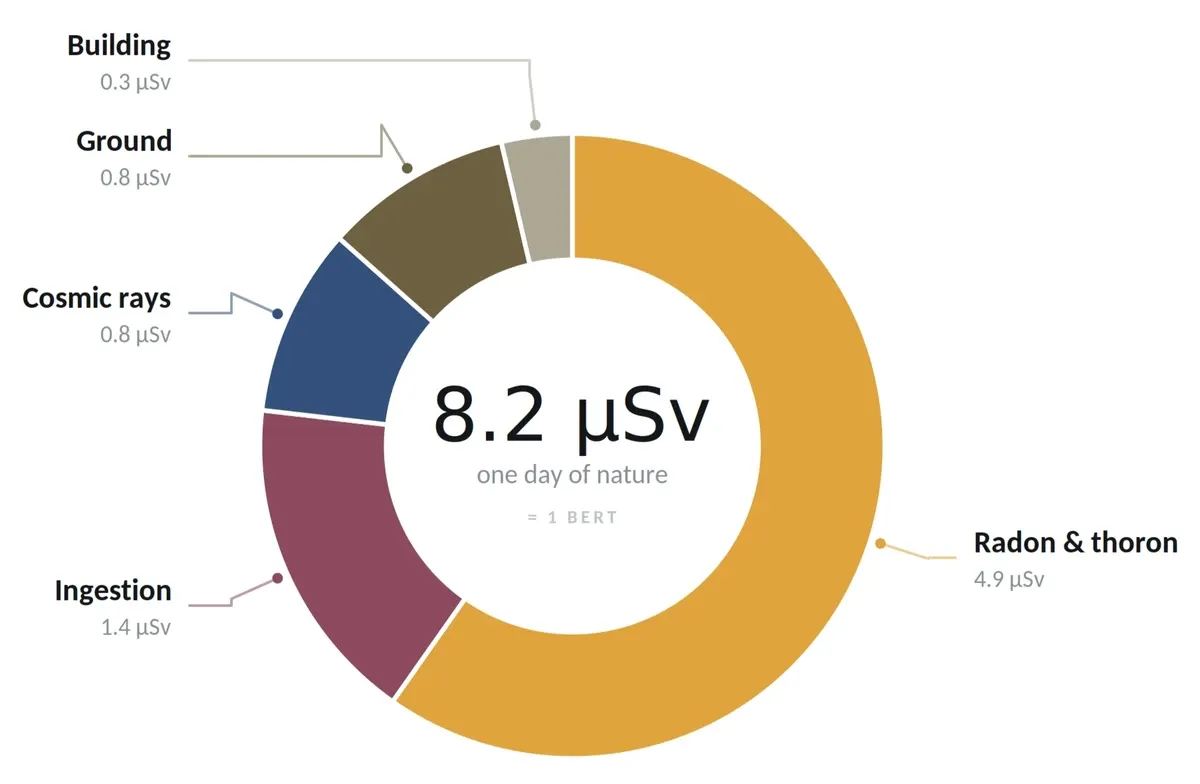
Call that one day of nature. This is called BERT - Background Equivalent Radiation Time - where 1 BERT = 1 day of background radiation.13 We can now use this to explain radiation, because hospital radiation and natural radiation are the same physics.14
As a small aside, 1 BERT = 82 bananas, for our outdated banana unit. This could be used to conclude that 1 banana costs you 1/82 days, or 18 minutes of life, but as we’ve seen from how your body works with bananas, it’s not quite like that.
Is 1 BERT a lot? A bit of biology
Not really - and the reason is that your cells have been handling DNA damage since long before anyone built X-ray machines. DNA damage is substantially more routine than you’d expect.
Every day, cells are able to detect damage, pause, and repair it. If the damage turns out to be beyond fixing, it does not carry on regardless: it retires permanently (senescent cells, alive but never divide again15) or destroys itself (called apoptosis). Cells have anti-cancer mechanisms acting all the time because damage happens all the time, only very rarely do the repair mechanisms themselves fail, which with the right kind of DNA damage can lead to tumours.16
In fact, radiation is the smallest source of DNA damage. Simple aerobic metabolism (aka breathing) causes damage way way more often17. What makes radiation damage slightly harder to deal with is how it lands: it deposits energy along tracks, so lesions arrive in tight clusters rather than scattered one at a time, and clustered damage repairs badly.18
The truth is that no one in the field knows the extent to which 1 BERT has risk or not. On the one hand, natural radiation cannot account for most cancer rates, so it is a small effect our bodies are largely ready for. Indeed, the largest study of its kind followed 70,000 residents of Karunagappally in Kerala, India - where natural radiation runs to 5 BERT and beyond19 - for over a decade, and found no excess cancer risk from the extra exposure.20 Yet at the same time, we cannot exclude the obvious risk radiation has, so it is still something as years go by.
Example 1 - Medical exams
Now we can address the original question, by converting X-rays into BERTs, or the equivalent of our daily exposure in nature:
| Procedure | Dose | In days of nature |
|---|---|---|
| 1 BERT (one day of nature) | 8.2 µSv11 | 1 day |
| Dental X-ray | 5 µSv21 | ~15 hours |
| Chest X-ray | 100 µSv22 | ~12 days |
| Mammogram | 280 µSv23 | ~34 days |
| PET tracer | 7 mSv24 | ~2.3 years |
| CT abdomen + pelvis | 7.7 mSv25 | ~2.6 years |
This is insightful - a dental X-ray is less than a day of being alive; it is pretty much irrelevant. Your dentist may hide because they do A LOT of them, while you only do one here and there. Most X-rays are totally fine under normal circumstances, in fact, you already do about 30 chest X-rays per year every year, so your 31st won’t kill you. On the other hand, PETs and CT scans are more than two years of nature delivered in one go - those are real numbers worth not taking lightly, and it may be an even better intuition that what “77,000 bananas” conveys.
Example 2 - Flying
Cosmic rays dose roughly doubles every 1,800 m, so at cruising altitude you’re above most of the shielding atmosphere and the rate jumps roughly 100x over ground level.26 Per one-way trip:
- European hop (~2h flight): ~5 µSv26 ≈ 15 hours of nature ≈ one dental X-ray
- New York → Los Angeles: ~40 µSv27 ≈ 5 days
- Transatlantic (~8h): ~50 µSv28 ≈ 6 days
A return trip across the Atlantic costs you twelve days of nature - one chest X-ray, bought with the ticket. Either worry about X-rays AND flying, or worry about neither. Reality is that unless you are aircrew, it is worth knowing about without much worrying.26
Example 3 - Romantic life
We stated above that your own body is the second biggest source of radioactivity you receive. That begs the question: when you sleep next to your partner, given they are another radioactive source lying against you, should you be worried? Let’s do the math, it will require some approximations.
-
Bodily radiation travels mostly very short distances, only gamma radiation escapes and this constitutes roughly 10.3% of the internal radiation.2 Then only roughly half of that is absorbed by your partner’s own torso on the way out.c This is a win: ~95% of what your partner radiates is for themselves, not to you.
-
From the calculation in the bananas section above, 140g of K-40 lead to ~4400 Bq of radiation in your partner’s body. This means your partner emits 4400 * 0.103 * 0.5 ~ 227 photons per second to open air. If you are spooning with your partner, i.e. covering their back or their front, let’s say you cover about 40% of their body surface: ~100 photons per second enter you. Out of those, roughly half (50 photons) deposit energy inside of youd.
-
Given photon energy of 1.46 MeV (1.46 MeV = 2.34 × 10⁻¹³ J) spread over a 70kg body:
-
Assuming about 4h of close cuddling per night as an average, after a full year of sleeping together we have:
A year of nightly spooning is under three hours of nature. To accumulate a single dental X-ray you’d need to do it for six years. All in all, you can keep enjoying yourself.
Example 4 - Where you live
Geography can move your BERT by about 10x.29
As we’ve seen cosmic dose roughly doubles for every 1,800 m of altitude, so cities like Denver have close to twice the cosmic dose compared to sea level.30 On top of that, local radiation sources also contribute greatly, such as Colorado’s uranium-rich ground that pushes terrestrial gamma to 1.6 µSv/day, 8x more than in Orlando.31 When you add everything together, moving to Denver doubles your BERT.19 You live 730 days of nature per 365-day year, and with it you do 30 more chest X-rays per year.
Interactive Demo 💡
Example 5 - Career
Would you guess that someone working outdoors soaks up more or less radiation than someone at a desk all day?
Radon gas is the main decider: it is an indoor gas, and buildings trap it. In open air it delivers 10x less radiation than inside houses.32 On top of that, building materials containing elements like potassium naturally increase your radiation rate, as we saw in the BERT breakdown above. The only thing the outdoor worker gains is cosmic radiation, as buildings block ~10% of it.33 Stacking it up:e
- Outdoorsy (half the day outside): ~6.8 µSv/day ≈ 0.8 BERT
- Average (~80% indoors): 8.2 µSv/day = 1 BERT (by definition)
- Indoor life (~95% indoors): ~9.6 µSv/day ≈ 1.2 BERT
So the person at the desk out-doses the hiker, though only by about ±20%.
Example 6 - Chernobyl
Just to make sure we scale things properly, let’s measure in BERT the radiation in this popular far end.
A guided day-tour of the exclusion zone today reads about 4 µSv on a dosimeter34 - half a day of nature. This is less than your flight there.
On the other hand, the average liquidator (the people sent to clean up the accident) in 1986 absorbed ~120 mSv:35
That’s a lifetime in a day, understandably damaging. And the firefighters on the roof that first night took up to 20 Sv:3
Delivered in an evening. That is a factor of 5 million between today and that first night. But the problem is not just the radiation causing cancer - that much dose in an evening grants acute radiation sickness, where your organs start failing because your body doesn’t have time to repair enough cells fast enough.36 Sadly, this was certain death, as the lethal dose is around 8 Sv - about 2,700 years of nature, well under half of what they took.36
So what is actually dangerous?
The thresholds, in days of nature:
- Lowest detectable cancer-risk bump: ~100 mSv = 33 years37
- Acute radiation sickness begins: ~0.7 Sv = 230 years3
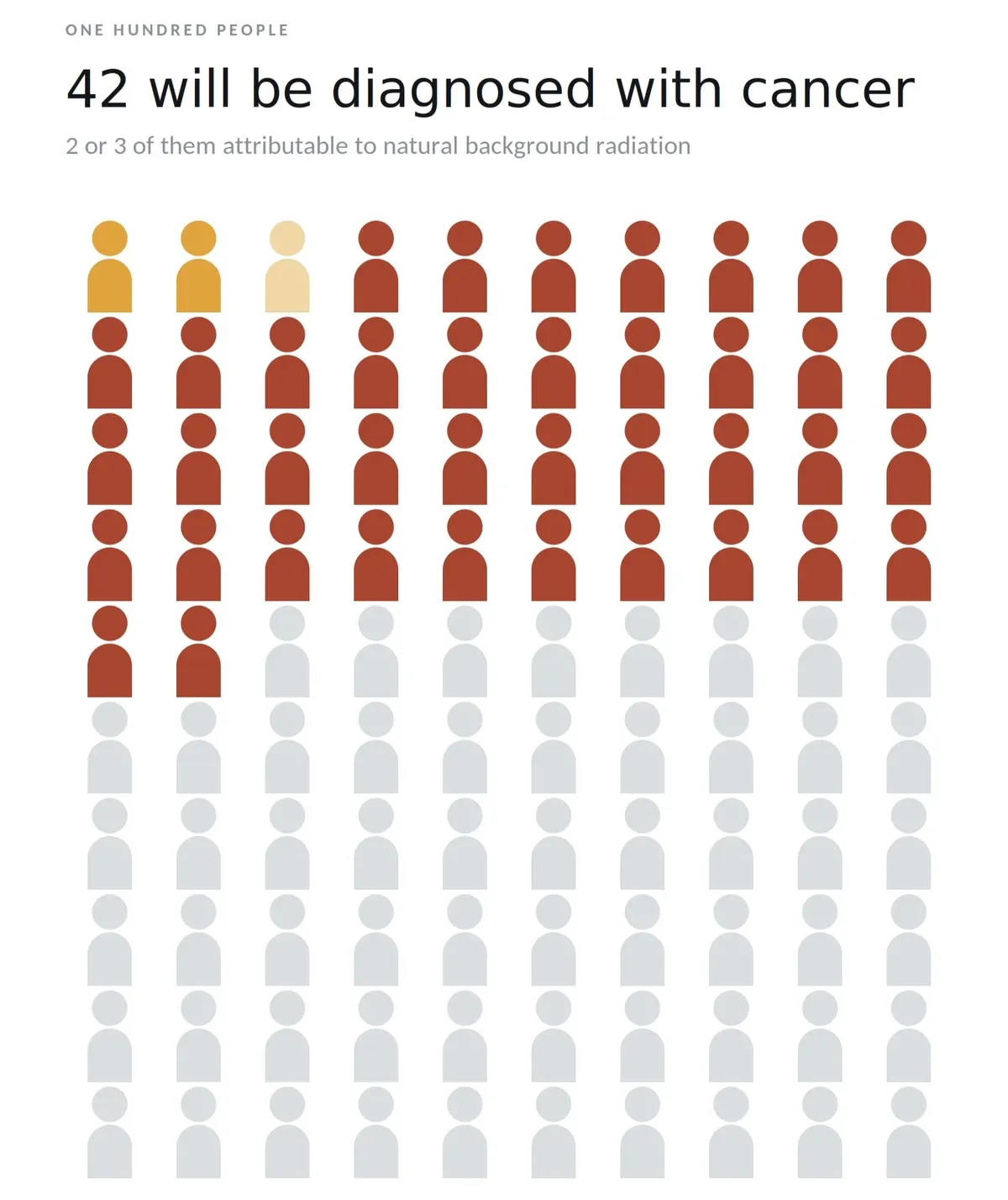
By your mid-thirties you have quietly accumulated the dose that sits at the edge of what epidemiology can detect. But “undetectable” is not “harmless”. The benchmark is that, in general, out of 100 people, about 42 will be diagnosed with cancer at some point, and a single 100 mSv dose is expected to cause roughly one more.37 Hence, a lifetime of BERT background comes to:
This means that background radiation accounts for 2 or 3 out of 42 cancers, about 1 in 17 of all cancers (~6%).f Nobody has confirmed that figure, but a bit more or a bit less, there is plenty of cancer rate to explain from other causes.
The Verdict
The banana is still a cool trick, but it measures a dose you never keep. Once we swap it for what we can’t avoid, here is the summary:
- 🟢 A banana ≈ 18 minutes of being alive
- 🟢 A year of sleeping beside someone ≈ 2.6 hours
- 🟢 A day touring Chernobyl today ≈ 12 hours
- 🟢 European short flight ≈ 15 hours
- 🟢 Dental X-ray ≈ 15 hours
- ⚪ 1 BERT = one full day of nature = 24 hours (the ruler itself)
- 🟢 Transatlantic flight ≈ 6 days (12 days for the return trip)
- 🟢 Chest X-ray ≈ 12 days
- 🟢 Mammogram ≈ 34 days
- 🟡 Moving to Denver ≈ +365 days, every year
- 🟡 PET scan / CT scan ≈ 2+ years
- 🟡 A Chernobyl liquidator in 1986 ≈ 40 years
- 🔴 A lethal dose ≈ 2,700 years, delivered in one evening
- 🔴 A Chernobyl firefighter that first night ≈ 6,700 years, in one evening
The fear scales with the lead apron, not with the dose, so worry not. But next time you fly, you can very well bring one with you (it’s legal yes!).
Notes
a The warming figure: 5 Gy is 5 J/kg, and soft tissue has a specific heat of roughly 3,500 J per kg per °C, so 5 ÷ 3,500 ≈ 0.0014 °C. Note that ~5 Gy is the LD50 - the dose at which about half of those exposed die without treatment - while 8-10 Sv is near-certain death even with intensive care, which is the figure used in the Chernobyl section below.
b The ground/building split is my estimate, derived from the UNSCEAR rates.12 Outdoors you receive the ground alone (59 nGy/h); indoors you receive the ground plus the building (84 nGy/h), so the building contributes the 25 nGy/h difference. The ground is beneath you all the time, the building only ~80% of it, giving mSv/yr from the ground against mSv/yr from the building - a 75/25 split, applied here to the 1.1 µSv/day terrestrial total. It assumes the floor blocks little ground gamma; if it blocks more, the building’s share rises, so 0.3 µSv/day is a lower bound.
c A body is not a point source and self-absorbs a good share of its own gammas (techically speaking, the mean free path in tissue of gamma rays of 1.46 MeV is ~17 cm). The 50% escape fraction is my guesstimate for us to get an order-of-magnitude, which is what I am interested in.
d Same reasoning in reverse for the energy that lands in you: with a ~17 cm mean free path against a torso a good deal thicker, roughly half of each gamma’s energy is absorbed and the rest passes through. Another order-of-magnitude guesstimate - together with the 40% coverage, the answer is good to about a factor of two, which is plenty to settle whether this matters.
e These three lifestyle figures are my own construction, built by re-weighting the UNSCEAR component doses11 using the indoor/outdoor radon32 and terrestrial12 rates and the cosmic shielding factor.33 They’re illustrative and you can treat them as having an error of ±0.8 µSv/day.
f That 1-in-100-per-100-mSv benchmark is not a raw exposure number. The underlying risk estimates come mostly from the atomic bomb survivors, who took their dose in an instant, so BEIR VII applies a downward adjustment - a dose and dose-rate effectiveness factor of 1.5 - on the assumption that the same dose spread thin is less carcinogenic. ICRP and NCRP use 2 instead.38 The figure above is already the slow-exposure version.
Sources
1 The ionising boundary is conventionally placed at a photon energy of 10-33 eV, which falls inside the ultraviolet band: high-energy UV photons (10-124 nm, or 124-10 eV) do ionise, but the atmosphere absorbs them, so only lower-energy non-ionising UV reaches the ground (Radiation Safety, Open Oregon; ScienceDirect, Ultraviolet Radiation). https://openoregon.pressbooks.pub/radsafety130/chapter/ionization-defined/ ; https://www.sciencedirect.com/topics/immunology-and-microbiology/ultraviolet-radiation
2 K-40 emits a 1.46 MeV gamma in ~10.3% of decays; ~89.6% beta (Wikipedia, Potassium-40). https://en.wikipedia.org/wiki/Potassium-40
3 Worst Chernobyl firefighters up to ~20 Sv; acute radiation sickness begins ≈ 0.7 Sv, LD50 ≈ 4-5 Sv, 8-10 Sv universally fatal (World Nuclear Association). https://world-nuclear.org/information-library/safety-and-security/safety-of-plants/chernobyl-accident
4 Quality factors Q = 1 for X-rays, gammas and betas; Q = 20 for alpha particles (EPA FGR-11 / ICRP). https://www.epa.gov/sites/default/files/2015-05/documents/520-1-88-020.pdf
5 Banana ≈ 0.5 g potassium, ≈ 15 Bq (Wikipedia, Banana equivalent dose). https://en.wikipedia.org/wiki/Banana_equivalent_dose
6 Banana equivalent dose and Potassium-40 (Wikipedia): 1 BED ≈ 0.1 µSv; K-40 is 0.0117% of natural potassium; half-life 1.25 billion years. https://en.wikipedia.org/wiki/Banana_equivalent_dose ; https://en.wikipedia.org/wiki/Potassium-40
7 EPA Federal Guidance Report No. 11 (1988), Table 2.2: committed effective dose for ingested K-40 ≈ 5.02 × 10⁻⁹ Sv/Bq, with the caveat that it is not appropriate where natural-potassium intake is elevated. https://www.epa.gov/sites/default/files/2015-05/documents/520-1-88-020.pdf
8 Potassium homeostasis: body holds ~140 g potassium, excess excreted; K-40 levels are unaffected by diet (Wikipedia, Potassium-40; US NRC). https://en.wikipedia.org/wiki/Potassium-40
9 Truckload of bananas can trigger port radiation portal monitors (Wikipedia, Banana equivalent dose). https://en.wikipedia.org/wiki/Banana_equivalent_dose
10 ~100 million bananas/year for a lethal dose (ETN, Banana Equivalent Dose). https://etn.redmud.org/banana-equivalent-dose/
11 UNSCEAR 2024 Report, Annex B, Evaluation of public exposure to ionizing radiation, announced February 2026: worldwide average natural dose ≈ 3.0 mSv/yr - radon and thoron 1.8, ingestion 0.5, terrestrial 0.4, cosmic 0.3. The rise from the earlier 2.4 mSv/yr reflects better data coverage, not an actual increase in exposure. https://unis.unvienna.org/unis/en/pressrels/2026/unisous453.html
12 UNSCEAR population-weighted world averages for terrestrial gamma: 59 nGy/h outdoors against 84 nGy/h indoors, giving 0.07 and 0.41 mSv/yr. Effective dose uses the UNSCEAR conversion of 0.7 Sv/Gy from absorbed dose in air, with occupancy factors of 0.8 indoors and 0.2 outdoors. https://www.sciencedirect.com/science/article/pii/S2773183925000072 ; https://pmc.ncbi.nlm.nih.gov/articles/PMC8636494/
13 Background Equivalent Radiation Time: 1 BERT = one day of average background dose; the concept is due to Prof. J. R. Cameron (Wikipedia, Background radiation equivalent time). https://en.wikipedia.org/wiki/Background_radiation_equivalent_time
14 BERT in clinical use: converts a dose to an equivalent period of natural background (Journal of Nuclear Medicine Technology, 2001), while avoiding mention of risk and conveying that man-made and background radiation are the same (Ng & Cameron, IAEA INIS). https://tech.snmjournals.org/content/29/3/156 ; https://inis.iaea.org/records/kh6vt-ypy15
15 p53 halts the cell cycle after DNA damage to allow repair; extensive or irreparable damage instead triggers apoptosis or senescence (Int. J. Mol. Sci., 2024). https://www.mdpi.com/1422-0067/25/23/12928
16 Apoptosis is the most effective tumour-suppression mechanism following DNA damage, because it eliminates cells carrying irreparable damage (Cell Division / PMC, 2010). https://www.ncbi.nlm.nih.gov/pmc/articles/PMC2822757/
17 As many as 50,000 DNA lesions are induced daily in each cell by reactive oxygen species formed as a by-product of aerobic metabolism (Clinical Oncology, 2013). https://www.sciencedirect.com/science/article/pii/S0936655513002471
18 BEIR VII: radiation products differ from metabolic oxidation products in the microdistribution of damage rather than its chemistry - clustered lesions are harder to repair. https://www.ncbi.nlm.nih.gov/books/NBK230458/
19 Average annual dose ~300 mrem in Boston, ~600 mrem in Denver, ~1,500 mrem in Kerala, India (ATSDR, Toxicological Profile for Ionizing Radiation). https://www.ncbi.nlm.nih.gov/books/NBK597564/
20 Karunagappally cohort study, Kerala: 69,958 residents followed for 10.5 years (736,586 person-years, 1,379 cancer cases). Poisson regression showed no excess cancer risk from terrestrial gamma radiation, with an excess relative risk of -0.13 per Gy (95% CI -0.58 to 0.46) (Nair et al., Health Physics 96(1):55-66, 2009). https://journals.lww.com/health-physics/fulltext/2009/01000/BACKGROUND_RADIATION_AND_CANCER_INCIDENCE_IN.8.aspx
21 Single intraoral dental X-ray ≈ 0.005 mSv (RadiologyInfo.org). https://www.radiologyinfo.org/en/info/safety-xray
22 Chest X-ray ≈ 0.1 mSv (RadiologyInfo.org; American Cancer Society). https://www.radiologyinfo.org/en/info/safety-xray
23 Standard 2D screening mammogram ≈ 0.28 mSv (American Cancer Society). https://www.cancer.org/cancer/diagnosis-staging/tests/imaging-tests/understanding-radiation-risk-from-imaging-tests.html
24 FDG-PET tracer ≈ 7 mSv from a ~370 MBq injection (0.019 mSv/MBq, ICRP 106). https://www.imagewisely.org/Imaging-Modalities/Nuclear-Medicine/Optimizing-Oncologic-FDG-PETCT-Scans
25 CT abdomen + pelvis ≈ 7.7 mSv (American Cancer Society). https://www.cancer.org/cancer/diagnosis-staging/tests/imaging-tests/understanding-radiation-risk-from-imaging-tests.html
26 Cosmic dose doubling with altitude; short-haul Europe 1-3 µSv/h; aircrew 2-5 mSv/yr (ScienceDirect). https://www.sciencedirect.com/topics/biochemistry-genetics-and-molecular-biology/cosmic-radiation
27 Cross-country US flight (NY-LA) one-way ≈ 0.02-0.05 mSv (US EPA RadTown). https://www.epa.gov/radtown/cosmic-radiation
28 Roundtrip Frankfurt-New York ≈ 100 µSv, so ~50 µSv one-way (German Federal Office for Radiation Protection, BfS). https://www.bfs.de/EN/topics/ion/environment/air-soil/flight/flight_node.html
29 The range of average annual effective dose to the public from natural sources is about 1-14 mSv across country and regional averages (UNSCEAR 2024 Annex B summary). https://www.sciencedirect.com/science/article/pii/S2666555726000808
30 Denver cosmic dose ≈ 50 mrem/yr against ~26 mrem/yr at sea level (Stanford EH&S). https://ehs.stanford.edu/manual/radiation-protection-guidance-hospital-staff/natural-sources-radiation
31 Terrestrial dose ranges from 7.4 mrem/yr in Orlando to 57.4 mrem/yr in Denver (US NRC). https://www.nrc.gov/docs/ML1224/ML12240A227.pdf
32 Radon dose ≈ 0.1-0.2 mSv/yr in open areas versus ~2 mSv/yr in houses (CERN radiation protection). https://arxiv.org/pdf/1303.6519
33 Buildings shield cosmic rays by ~10%, more for large concrete structures (US National Research Council, Indoor Pollutants). https://www.ncbi.nlm.nih.gov/books/NBK234054/
34 Exclusion-zone day tour ≈ 3-5 µSv over 10-12 h (operator dosimetry). https://chernobylx.com/radiation-safety-and-protection-chernobyl/
35 Average liquidator dose ≈ 120 mSv (Wikipedia / UNSCEAR). https://en.wikipedia.org/wiki/Chernobyl_liquidators
36 Acute radiation syndrome is a deterministic effect: above roughly 1 Sv, cell killing outpaces replacement in the bone marrow and gut lining and the tissue itself fails. An acute whole-body dose of 8 Sv kills with ~99% probability, and 8-10 Sv is considered universally fatal even with intensive care; more dose is needed for the same effect if it arrives over hours or longer (Nuclear Power / Radiation Dosimetry; World Nuclear Association). https://www.nuclear-power.com/nuclear-engineering/radiation-protection/radiobiology/deterministic-effects/lethal-dose-of-radiation/ ; https://world-nuclear.org/information-library/safety-and-security/safety-of-plants/chernobyl-accident
37 BEIR VII Phase 2: approximately 1 person in 100 would develop cancer from a dose of 100 mSv, while approximately 42 of 100 would develop cancer from other causes (National Academies, 2006). https://nap.nationalacademies.org/resource/11340/beir_vii_final.pdf
38 A dose and dose-rate effectiveness factor is applied to acute-exposure risk estimates when they are used for low doses or low dose rates; ICRP and NCRP use 2, while BEIR VII estimated 1.5 (BEIR VII Phase 2, Ch. 2; Health Physics commentary). https://www.nationalacademies.org/read/11340/chapter/4 ; https://pubmed.ncbi.nlm.nih.gov/25627947/